Five Things That Could Put the CS2 Market Back Where It Was
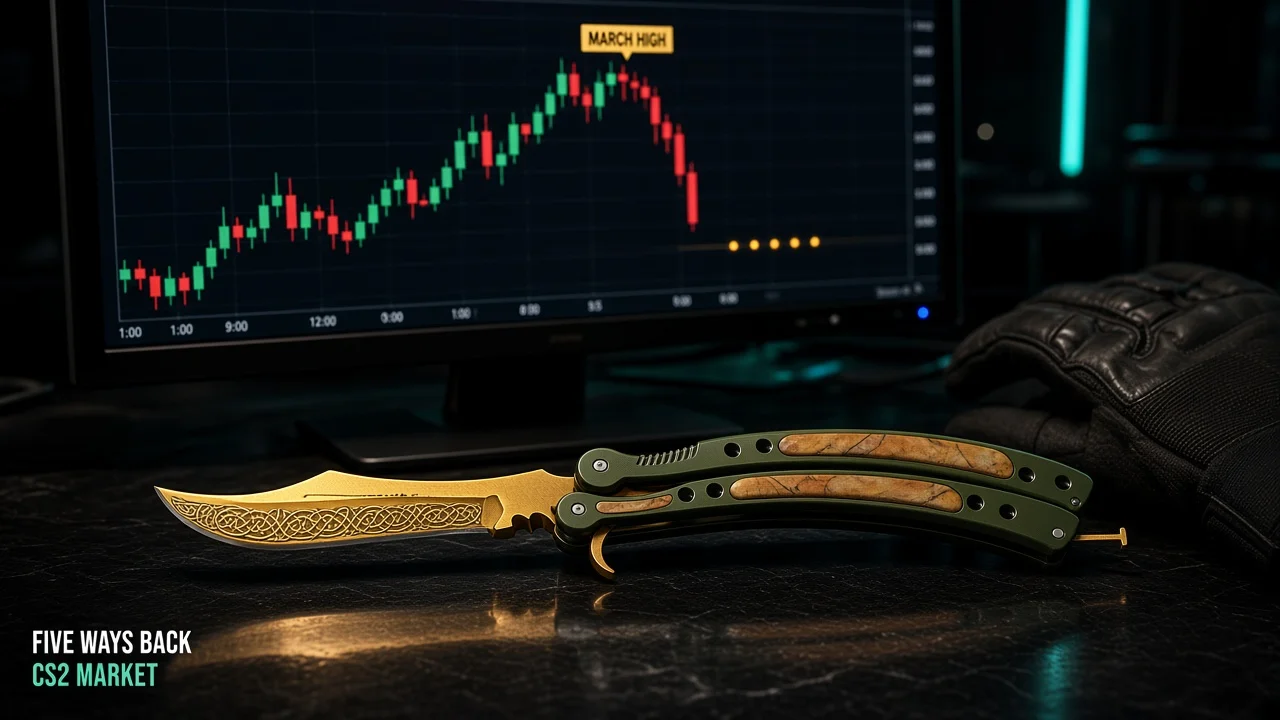
The CS2 skin market did not die on a single patch in March 2026. It made a high, then spent the next half year leaking. On 16 March 2026 third-party trackers put capitalization back near $9.5 billion, level with the December 2025 rebound. By 21 August, PriceEmpire's print was about $6.77 billion. CSMarketCap sat lower, near $6.12 billion on 19 August, and was still red on the week. On this site the Steam market sum was $6.81 billion on 9 September, down about 14.8% over 90 days. The rulers do not match. The direction does.
That March print is the "previous level" worth talking about. The October 2025 high, near $10.4 billion on the same trackers, already belonged to a different market: the one from before five Covert skins could become a knife. Getting back to the spring ceiling is a supply problem and a trust problem. Since March, the loudest answers on Reddit, in trade write-ups, and in the major-sticker fallout keep landing on the same five moves.
What the Tape Has Been Saying Since March
Three products kept running while the index fell.
Dead Hand. On 11-12 March 2026 Valve released the Dead Hand collection through a terminal, with a new glove set as the rare special. You see an offer and pay it, or you pass. The terminal entered the weekly Prime drop pool. Secondary guides put its share near a third of those drops. Through spring, posts on r/cs2 tracked sealed terminal prices sliding from the mid-teens toward about $8, cheap enough that the new route undercut grinding cases for a gold. New gloves arrived in volume. Older glove bids softened next to them. The complaint was specific: Valve now names the price, and knives could be next.
The Armory hose. The pass sat still long enough for farms to bank stars. When Arabesque and Spy Tech rotated in, that stockpile hit at once. Write-ups of those collections called the return a record low, with Factory New odds cut at launch and most wears landing near consumer prices. A quiet Armory is not a pause. It is a warehouse.
Cologne's Major Shop. On 22 May 2026 sticker capsules were replaced by tokens. You redeem a specific sticker, and the price moves with demand. Early June reports put one copy of each of the 100 most expensive Cologne stickers near $19,400, with a single sticker above $1,500. Ordinary supporters stopped buying repeats. Organizations felt the gap: a Stage 1 team was reported around $60,000 in sticker money, against figures near $600,000 out of Budapest. Those payouts are unaudited, and Valve has not published them. The gap was wide enough that Twistzz called the system damage to the whole ecosystem. A major week used to pull fresh cash in. This one repriced stickers a normal fan would not apply.
One later event shows the scale of what a supply cut can and cannot do. On 6 August 2026 a farm-ban wave ran about twenty times a normal day and climbed past 26,000 accounts. In a sample of more than 21,000, trackers found a single VAC ban. The rest were game bans, clustered on Wingman, where a farm can fill the lobby with itself. Frozen inventories added up to roughly $40,000 to $55,000. Useful housekeeping for the next drop cycle. A rounding error next to a slide measured in billions.
The older complaints sit underneath that tape. The last full operation was Riptide, in 2021. On 22 October 2025 the covert-to-gold trade-up went live, and Bloomberg put the overnight hit near $1.75 billion. Players have spent years asking for missions and a reason to queue that is not a store tab. Holders have spent the year since October asking Valve to stop editing scarcity in a patch note. The five ideas below are those two conversations, aimed at the leak that started in mid-March.
1. Ship an operation that ends
The Armory is the operation Valve shipped. Players clocked the swap. Threads in May 2026 were still just "bring operations back": missions, a grind, a skin you work toward, then a pass that closes. The usual reply underneath is that the Armory already is that system, minus the missions, and it does not close.
The market cares about the ending. Shattered Web, Broken Fang, and Riptide pulled people into the client, sold a pass, and stopped. A collection that stops can hold a bid. A terminal that stays in the weekly pool, and an Armory that never expires its stars, add supply in every week the index is already red.
An operation that would matter in this tape is a dated pass. Missions or a mode people queue, one collection, a published end date, and a rare special that does not sit on top of knives already in circulation. That is the only format this game has used that creates demand first and scarcity after. The March terminal showed you a glove and named a price. Demand did not follow.
2. Close the new-gold hose on a calendar
Dead Hand did not have to gap the March high on day one. It had to keep printing. A terminal near a third of Prime drops, with offers cheap enough to beat the old key math, is a glove factory. March posts were about Dead Hand gloves whipping 20% to 30% in a day. The summer version of that post was quieter and more important: more terminals opened, more gloves existed, the floor kept stepping down.
The Armory does the same thing on a delay. Farmers do not dump while the pass is quiet. They dump the week Valve adds a collection. Arabesque and Spy Tech opened into months of saved stars. The market received quantity.
The fix people describe is a date on a page. Pull Dead Hand out of the weekly pool on a day you announce in advance. Rotate the Armory before stars can sit for a season. Cap stars, or expire the unused ones when a collection leaves. "Last chance" only works when the chance ends. Every open terminal and every unspent star is a reason to wait, and a market full of people waiting is how a high becomes a grind.
3. Leave knife scarcity alone
Capitalization is a pyramid. Coverage of the 2026 tape puts more than 60% of skins under $10, and only about 1.1% of items above $1,000. The headline moves when that thin top moves. October 2025 is the proof: five Coverts became a knife or gloves, premium supply jumped, and the index gapped. Bloomberg's figure was about $1.75 billion in a day. The market then spent five months climbing back toward $9.5 billion, and lost that climb after March.
The fear on trade threads since Dead Hand is narrow. The terminal priced a glove. A later terminal that prices a knife the same way turns the March ceiling into a level that gets competed away. Players who want a cheaper loadout will cheer. The capitalization number lives in the items they just made common. A return to $9.5 billion requires those items to stay scarce.
So the third move is a refusal. Keep the next knife out of a terminal. Leave the covert-to-gold rule where October put it. New finishes can live in a case or an operation collection whose special item is not a second knife tier. Another scarcity reset produces a lower high.
4. Give majors a limited sticker print again
Cologne was the live test of direct purchase. It was cleaner legally, and it sold less of the behavior that used to fund the scene. Capsules made people buy repeats, then apply the hit and destroy supply. The token shop made them buy once, then watch popular stickers run to four figures. Where team payouts were reported, they came in far under the Budapest capsule era. A shop of stickers nobody applies is inventory. An applied capsule meta is a sink.
The repair already sitting in the Cologne post-mortems is narrow, and it does not require walking back into a lawsuit. Fixed prices. A ceiling. A hard close when the major ends. A print small enough that crafting a sticker still removes it from the float. A hybrid - a capsule where random opens are legal, and a fixed shop where they are not - is one of the versions already written down in that coverage. Legacy capsules can stay rare. The live major has to be something a normal supporter buys, or the week never reaches a multi-billion index.
5. Publish the rules, and keep farms unprofitable on a clock
The August wave aimed at the right accounts. Wingman shells, empty inventories, a handful of storage accounts, almost no VAC. Reports from farming communities described fleets cut by most of their size. One operator went from more than 250 accounts to about ten. If that cadence holds, stocking stars for the next collection stops paying. That supports the calendar in idea 2. It does not, on its own, bid the index back to March. Fifty thousand dollars frozen is not three billion dollars of lost cap.
What the index still prices is surprise. October 2025 changed trade-ups in a line of patch notes. March 2026 changed how you buy a glove. May 2026 changed how a major makes money. Each time, holders learned that the scarcity they paid for was a setting. Steam threads after the trade-up asked for the plain thing: say it before it ships. A market that can be rewritten overnight carries a discount. That discount is part of the gap between the high-$6 billion range and the March print.
The practical version is short. Post the drop-pool share, the day a terminal leaves it, and the trade-up formula before the update. Hit Wingman farms on a steady clock so the supply cut is expected. A published rule that the next collection cannot be farmed in advance is how new supply stops leaning on the tape.
What Does Not Turn This Tape
- Another terminal with a moving price. That product launched in March. The high did not hold.
- A cheaper Armory drop. Record-low ROI on the last collections is the leak.
- One ban wave. August removed future farm drops. The missing bid is still missing.
- A major week whose shop fans cannot afford. Cologne already ran it.
- Chinese tax notices on large third-party trades, and the New York case. Real headline risk. Neither is a patch.
Bottom Line
From mid-March 2026 the market has ground off a $9.5 billion second peak toward the high-$6 billion range, on PriceEmpire and on this site's Steam sum. The items people name are concrete: a glove terminal that stayed in the drop pool, Armory stars that sat too long, a major shop that priced fans out, and a year of rule changes that taught holders to sell first.
The five replies that show up, inside that window and long before it, are an operation that ends, a calendar that shuts new gold supply, knife scarcity left alone, a limited major sticker again, and economy rules published before they trade. None of them rewinds October 2025. Together they are the path people have actually described for adding a bid while the hoses stay shut.
Markets move. Liquidity changes. Nothing here is financial advice, and cs2skinswiki.com is not affiliated with Valve. Watch the Steam market sum. If it is still making lower highs while terminals and the Armory stay open-ended, the March level stays a story.